
Categories
Careers, Working in Real EstatePublished August 14, 2026
Real Estate Agent Training: What to Expect in Your First Year

EXEC SUMMARY
This article covers what quality real estate agent training looks like in year one, regardless of which brokerage or team you join. You will find: what good onboarding actually includes in the first 30 days, how to tell whether a mentorship program is real or just a checkbox, how new agents should think about lead generation, the questions to ask before signing with any team or brokerage, and what the agents who build lasting careers do differently from those who leave before year two.
You passed your licensing exam. Now what? Most new agents describe the same moment: you have your license in hand, you are ready to start, and then you realize nobody has actually shown you how to have a conversation with a real client. Real estate school covered property law and disclosure requirements. It did not teach you how to help a nervous buyer feel confident, write a strong offer under pressure, or build a pipeline when you are starting from zero.
At Premier Home Team, we have spent the last five years training and coaching new agents in the Philadelphia-area real estate market, and we have seen both sides of this. Agents who came in with nothing but a fresh license and built real, lasting careers. And talented people who walked out before year two, not because they could not do the job, but because the support structure around them was not there.
In this article, we’ll give you an honest picture of what great training and mentorship actually look like, regardless of where you choose to work. After reading this article, you will know:
- What training should really look like
- The value of true mentorship
- What happens after the first 90 days
- Red flags to watch out for
What Real Estate Agent Training Should Include
Before we get into specifics, here is something most brokerages will not say out loud: the basics of a good first year should not be a selling point. They should be a given.
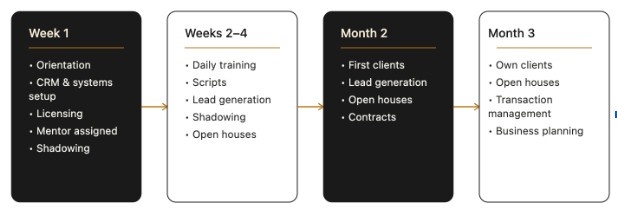
Whether you join a brokerage or team, you should have structured onboarding that goes beyond handing you a login and a CRM password. You should have a mentor who actually has time for you. You should have some kind of lead generation system, not just the advice to "call your sphere. You should have someone reviewing your offers before they go out, and you should be in an environment where asking questions is welcomed.
If a recruiter cannot clearly explain what your first 30 days look like, you have your answer.
What Do Real Estate Agents Do in Their First Year?
Learning to Talk to Clients
The biggest difference between real estate school and real-world training is learning how to communicate with clients. Strong onboarding teaches you how to guide conversations, build confidence, and navigate difficult questions before you're responsible for helping your first buyer or seller.
Real estate school gives you the legal framework. Good onboarding gives you the words, the confidence, and enough practice to have real conversations before your first client is counting on you. That gap is where most training programs succeed or fail.
Knowing the Contract Before You Need It
You do not need to master the Agreement of Sale in your first week, but you should understand it before you are sitting across from another agent who challenges you on the details.
A quality training program should help you become comfortable with the Agreement of Sale long before you're negotiating your first deal. Understanding how contracts work gives you the confidence to answer questions, navigate negotiations, and advocate for your clients when the pressure is on.
What catches most new agents off guard is not the transaction itself, but managing it alongside everything else. A deal does not pause your lead generation. Your pipeline does not care that you are in the middle of a home inspection. Learning to balance active transactions with ongoing prospecting is one of the real lessons of year one, and most training programs underestimate it.
How to Get Leads as a New Real Estate Agent
Your sphere of influence is where most first conversations come from. The people who already know and trust you will get you to your first transaction faster than any paid lead source.
Your sphere of influence is the foundation of your future business. Every conversation and every new contact builds a database that can generate referrals, repeat business, and future opportunities long after your first transaction.
A good team or brokerage should supplement what you cannot build on your own yet. There is a meaningful difference between saying "we provide leads" and actually having a system that routes real, active buyers to newer agents. Ask specifically how that works before you join.
What a Real Estate Mentorship Should Actually Look Like
One-on-One vs. One-Size-Fits-All
The clearest test for whether a mentorship program is real: ask how often you will meet one-on-one with a dedicated mentor.
If a brokerage focuses primarily on classroom training, that's often a sign the support will be one-size-fits-all. Classes have value, but they shouldn't replace regular one-on-one coaching with an experienced mentor.
Real mentorship is personalized. Everyone who comes into real estate brings a different background, different strengths, and different blind spots. A mentor who actually helps you grow understands where you specifically get stuck and helps you work through it, rather than putting you in a group session and calling it coaching.

How Long Does It Take to Become a Successful Real Estate Agent?
A lot of brokerages and teams front-load their support. The first three months have structure. Then it gets quiet.
Many brokerages and teams provide plenty of structure during onboarding but dramatically reduce their support after the first few months. That's why it's important to ask what coaching and accountability look like beyond the initial 90 days.
Good ongoing coaching has structure past the initial onboarding period. Look for accountability, regular check-ins, and mentors who tie their coaching to your actual numbers. The best coaching is rooted in objective performance, not opinions. Reviewing your numbers regularly helps identify where deals are falling through so you can improve the parts of your business that need the most attention.
How to Choose the Best Real Estate Brokerage for New Agents
Before committing to any brokerage or team, ask to speak with agents who joined in the last year. Ask what their business looks like now. Ask whether they still have access to their mentor.
Speak with agents who joined within the last year and ask what their business looks like today. Their experience will give you a much clearer picture of what ongoing training and support actually look like than any recruiting presentation. We've put together the specific questions to ask any brokerage before you sign, so you walk into that conversation prepared.
If the agents you speak to cannot tell you what ongoing support looks like, that is the answer.
What Separates New Agents Who Build Lasting Careers
When we look back at agents who thrived in year one versus those who quietly left before year two, one trait stands out more than any other.
The agents who build lasting careers are the ones who consistently ask questions, seek feedback, and stay coachable. Rather than trying to solve every problem on their own, they lean on experienced mentors and continue learning throughout their first year.
Beyond that, success in year one often comes down to willingness. Real estate is competitive, and when you are new, the most reliable edge you have is outworking the people around you.
If you want to win, host open houses on the weekends, show past five, call when the people around you aren't doing that; just have the mindset to outwork everyone. That's the biggest difference we see.
There is also something worth understanding about the journey itself. What trips you up may never touch someone else, and what others struggle with may not apply to you at all. That is not a sign this career is not right for you.
Give it a full year. Real estate has lagging indicators. You may not see success until much later.
The Right Support Changes Everything
The decision about where to start your real estate career is one of the highest-leverage ones you will make. The training and mentorship you receive in year one shape your habits, your confidence, and your trajectory for years that follow.
You now know what to expect from a quality training program and, just as importantly, what questions to ask before joining any brokerage or team. That puts you in a much stronger position to choose a place that will help you build a lasting career, not just get through your first few months.
If you are weighing your options and want to see what year one actually looks like at a team built around agent development, the best next step is a conversation. No pressure, no pitch, just a real look at whether it is a fit.
Book a Career Consultation with Premier Home Team
Frequently Asked Questions
How long does it take to earn your first commission as a new real estate agent?
Most new agents close their first transaction within three to six months of getting licensed, but the timeline varies based on your market, your sphere of influence, and how consistently you are prospecting. Real estate has lagging indicators, which means the work you do in your first 60 days often shows up in your income several months later. Give yourself a full year before drawing any conclusions about whether real estate is working for you.
What is the difference between joining a real estate team and an independent brokerage?
On a team, you typically have more structure: a defined onboarding process, a mentorship program, and often access to leads the team generates. At a standalone brokerage, you have more independence but usually less built-in support, especially in the early months. For most new agents, a team environment provides a faster path to a first transaction because the infrastructure is already in place.
What questions should I ask a brokerage before I sign?
Ask how often you will meet one-on-one with a dedicated mentor. Ask what the first 30, 60, and 90 days look like in specific terms. Ask to speak with agents who joined in the last 12 months and find out what their business looks like now. Ask what ongoing coaching and accountability look like after the initial onboarding period ends. The answers to those questions will tell you more than any recruiting presentation.
What technology and marketing tools should a brokerage provide to new agents?
At minimum, expect access to a CRM that helps you stay in contact with clients and track where people are in the process, a transaction management system, and showing software. More importantly, look for a brokerage that actually trains you on those tools through experienced agents who use them every day, not just a video library and a getting-started guide.
Robin Martin
Realtor® | Premier Home Team | Keller Williams Empower | PLACE
or another way